



My Journey to Le Français Facile!: The Easy French
By Marie Filion, BS, BA, MS
The decision to teach a foreign language is one that most home educators ponder with great deliberation. There are many schools of thought, but few with much concrete information. I searched for which language and when to teach that language, and my journey took me on some unexpected turns.
I knew that I wanted to teach Spanish, French and Latin at some point in my children’s school career. I needed to know how best to teach them and which one to do first. This road lead me to consider frequency bands, the Great Commission, help with grammar, and ease of learning.
As I pursued my Entry Level in becoming a SAMONAS therapist, I discovered some amazing facts about how people learn languages. Frequency bands are the oscillations that the human ear can theoretically capture. These range from frequencies of 16-16000 Hz and include an infinite number of rhythms. As we get older our ears tend to settle into a habit, and remain efficient only in those frequencies and rhythms we use for our mother tongue. This habit is difficult to break out of. The French mainly use the frequencies from 1000 to 2000 Hz, while the English use frequencies which range from 2000 to 12000 Hz. We can see why each have problems learning the others language.
Each language therefore has a preferential use of certain ranges of sound frequencies, called basic frequency bands, as is demonstrated by the table below:
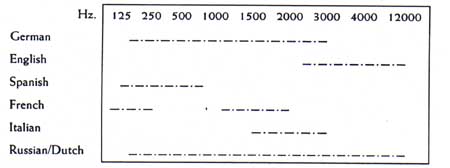
This is the reason why it is so important to learn a foreign language early in life. The child will have an easier time keeping their frequency bands open and therefore, be able to make the sounds more easily. As Dr. Alfred Tomatis’ research showed us, we cannot make sounds that we cannot hear.
If we choose to teach Latin as the first foreign language this does a disservice to children. Since Latin is a dead language and can only be spoken by people who have another mother tongue, those are the frequencies that will be passed on. An English person speaking Latin will speak the language in the 2000-12,000Hz. range. Latin is best taught at the high school level, so as to not waste the valuable younger years when the ear can more easily learn to hear new frequency bands.
Having decided that I should teach Latin last, the next step in my journey was to figure out which foreign language to teach first! Since my mother tongue is French and I took Spanish in university, these two languages were on the top of my list. I assumed that it would be easiest to teach French first, as this was my first language. As most people know, just because you speak the language does not necessarily make you an expert in teaching it. I had taught French as a Second Language in the public system, but had never found a curriculum that I liked. At that time, I had started to develop a better method that laid down basic knowledge and built from there. Life being busy, I kept my ideas, discoveries and assumptions for a later date.
I must have bought every possible French curriculum out there. You name it, we tried it. It was getting frustrating. My oldest daughter was now 10 and she still did not have much French under her belt. Since we use and love The Writing Road to Reading (The Spalding Method) for our English program, and I did a Psychology Degree with a concentration on how people learn to read, I decided to draw from my own knowledge. I first created the French phonograms and put Language and Spelling Rules with them.
I taught a group of non-Francophone homeschooled children for a year to see how my method would work. They did quite well. The foundational way that I had taught in the public system worked, but only to a degree. This program was dry. As I considered creating a full curriculum, I first let Spalding know of my intentions as the concept and basic approach are similar to their program. My creation of the French phonograms and the Language Rules could not legally have caused problems, however I use Spalding to tutor children in English and have a working relationship with them which I did not want to damage. They saw no reason why it would affect our relationship. I felt this gave me the “carte blanche” to go ahead.
My next decision had to be what my goals were with this curriculum. Did I want a conversational medium? Did I want grammar? Did I want stories? Did I want clear pronunciation as a goal? I wanted all of these and more. I also wanted this curriculum to follow Canadian and American requirements for second language training. Fulfilling the mandates of the Charlotte Mason Method was important, especially the research and discoveries laid out by François Gouin in his book The Art of Teaching and Studying Languages. I also wanted to consider The Principle Method, Bloom Taxonomy, research done by Dr. Jeanne Chall (that Spalding meets and exceeds) and above all else I wanted this curriculum to be easy for the student and the parent to teach. How in the world was I going to fulfill such a large number of requirements? The research began and continued for quite a while. The developing of the skeleton of the lessons took time, prayer and hard work. How I did it, was with the amazing Grace of Jesus Christ. I certainly could not have done it without Him! There were times that all the requirements swirled around in my head. I would check and re-check to make sure that all was in order.
As I began to write the storylines one more requirement was laid on my heart. We have four beautiful children. We have one very gifted, one with a learning disability, and great aspirations for all. Each of our children have great potential as do each of yours. In examining this potential I started to ask myself, “Potential for what?” I wasn’t quite sure at first. I knew that as a home educating mother I needed to teach them the basic 3R’s. What other subjects did I need? And where were we going with all these subjects? Was my ultimate goal to create very intelligent children who could wow anyone in any subject? Lofty goals, attainable maybe, but again for what purpose?
I began to realize that there was more than teaching our children their school subjects. There must be more than teaching how to concentrate on their intellect. Most people would agree in theory, but are we actually doing anything to explore where we are going and how we are to get there? Most would probably say no. Hey, it took me almost eight years.
If we examine Jesus’ final instruction to us, we find His Great Commission. Here is the scripture verse:
Matthew 28:19-20
Go ye therefore, and teach all nations, baptizing them in the name of the Father, and of the Son, and of the Holy Ghost: Teaching them to observe all things whatsoever I have commanded you: and, lo, I am with you always, even unto the end of the world. Amen.
I now knew that my curriculum must aid parents in preparing their children for The Great Commission. Now I had to determine how I was going to go about this. The teaching of French culture in many of the French speaking countries, the learning of French scripture, a strong Christian worldview and good moral stories filled with character and humor was the beginning. Why humor you ask? One of the best ways to witness to the French is through humor. Many of our idioms and customs show how much we have a joie de vivre (joy of living).
In an unexpected turn along my journey, I found myself revisiting Latin. As I examined the question of learning Latin in order to better understand English, I wondered what part of Latin would help. I could totally understand how the Latin roots could help in understanding the meanings of words, but Latin uses word endings to distinguish between parts of speech, not usage and location in a sentence as English, French and Spanish do. In this I could not understand how learning the whole Latin language could possibly help my children. With the knowledge of the language frequency bands in hand, I decided that our time could be put to better use learning modern languages and just learning the Latin and maybe Greek roots. In this, I have prepared Level II to include Latin roots and Level III to include Latin and Greek roots. The natural inclusion allows the child to learn the meat of what is needed, freeing up time to learn another complete language. Deeper understanding of English grammar can be accomplished by learning French and/or Spanish. Both these languages follow similar patterns in sentence construction. Further, a significant bonus is that you can gain additional insight into scripture, benefiting from the richness of meaning certain words carry, by reading it in various languages.
My journey was almost over; I had one more important leg. I decided that I needed to test this curriculum on some real live families. The way in which I teach French might be very different from the way an Anglophone teaches it. I contacted numerous families all over North America (from California to Nova Scotia) and ended up with over 40 families that were willing to try out the curriculum. Their comments, suggestions and ideas led to the further development and refinement of Le Français Facile!. I am very thankful to my beta testers and know that they share in my success.
As my journey ends, let me describe to you in brief what Le Français Facile! really looks like. Problem solving and creativity are enhanced when we choose to learn any foreign language using a program that is properly set up. Our cognitive flexibilities can increase, and we gain the ability to hear the full range of frequencies present in another language. Every good foreign language program should contain the following elements:
- phonology (the sound units which comprise language),
- morphology (word structure),
- syntax (the structure and rules of language),
- and/or semantics (the meaning of words)
Allow me to elaborate on how these elements are included in Le Français Facile!
Le Français Facile! is a new and innovative approach to learning French. One of its biggest strengths is that it is based on an explicit phonics model. The sounds of the language are all clearly defined, with the language rules for spelling and grammar being introduced as needed. Not only does this allow children to learn the language with excellent pronunciation, it also teaches them to think, helping them get to the highest of Dr. Jeanne Chall’s stages.
Jeanne Chall's Stages of Reading Development is an interesting theory to explore. Professor Chall was a Harvard University professor and a noted reading expert. Professor Chall in her book, Stages of Reading Development establishes the following stages: pre-reading, initial reading and decoding (letter-sound relations), confirmation and fluency (advanced decoding skills), reading to learn the new (comprehension), multiple viewpoints (reading and understanding complex material), and construction and reconstruction (synthesize and create new knowledge).
Level I of Le Français Facile! takes your child through the pre-reading, initial reading, and decoding stages (see a chart that summaries Dr. Chall’s stages with the levels of Le Français Facile! below). These three stages must be introduced in succession if future success is our goal. Children can memorize obscure lists of words, but will they truly understand the language and will they be able to attain higher decoding skills?
Dr. Chall’s Stages of Development and the levels of Le Français Facile!
| Le Français Facile! | Dr. Chall’s Stages |
|---|---|
| Level I 1-3 year program (depending on age of student) |
Letter-sound relations: pre-reading (yr. 1), initial reading and decoding (yrs. 2 &3) |
| Level II 2 year program |
Letter-sound relations: initial reading and decoding & starting advanced decoding skills Advanced decoding skills: confirmation and fluency |
| Level III 2 year program |
Comprehension: reading to learn the new Reading and understanding complex material: multiple viewpoints |
A number of different concepts and activities are used throughout Le Français facile! to ensure that the language is comprehensively understood leading to better learning and retention. Vocabulary is developed using the basic elements of cognates, phonograms, interesting stories, high frequency vocabulary and French Weave. Cognates are words that are the same or similar in English and French. These cognates make it very easy for a child to comprehend the context of the lessons. Phonograms are the basic sounds of the language. By coupling phonograms with cognates (which are familiar to the child and require less concentration than new subject content), the child is better able to concentrate specifically on pronunciation and phonemic awareness while acquiring a large vocabulary very quickly.
The program should take the average child 3 years to complete. The first year consists of 36 lessons, with the goal of completing one lesson per week. Audio exercises are scheduled daily during this time. As the program progresses comprehensively in the 2nd and 3rd years, lessons are scheduled biweekly. For the Independent Learner (a child able to work on their own), this level should take approximately one year to complete, but can be extended over a two year period. The teenager can use the Fast Track schedule to get to the meat of the curriculum without doing the simpler activities and exercises designed for younger children. The working charts in the program are adaptable to the younger child, the independent learner and the teenager. At the end of the program, a Certificate of Completion can be awarded with submission of work.
The audio recordings are done by native French speakers. The acquisition of a language is best done when hearing a multitude of different voices. The 1st semester has only female voices, as language is best initially learned from a female voice. A male voice is introduced in the 2nd semester. The French accent used is an International French. This is the easiest accent to learn French with. It is spoken in different parts of France and Canada. Level II introduces a Parisian accent. This accent is thicker and more difficult to pick up for the untrained ear. Level II’s audio also explores different accents from all over the world. This allows the listener to be introduced to the breadth of the French language and its accents on a global scale.
Everyone learns language by imitation. It is therefore important that a language program include audio components to ensure proper pronunciation, which Le Français facile! has provided. Proper pronunciation is vital for future enunciation. When practicing a new word, speak slowly and clearly, stretching it out for the child the same as you would teach phonemic awareness in the English language. The recordings of Everyday Vocabulary are done with this purpose in mind and provide the daily interaction. It is essential when learning a new language to impart to the child the technique of listening, while he/she refers to the phonograms (by their 3rd year), in order to establish an ear for a new language and its foreign sounds. This technique will lead to successfully mastering the language itself.
Most French programs teach with a whole language method, others make a veiled attempt at teaching some basic phonics. The major problem is that your brain has not been taught the sounds that you are attempting to make. The theories of sound (as previously introduced) tell us that if we cannot identify a sound, we cannot replicate that sound. If you would like to study further on this topic, please see the work done by Dr. Alfred Tomatis (The Tomatis Method) or Ingo Steinbach (SAMONAS).
In our effort to use all available technologies to further facilitate learning, we have used these theories when mastering our audio. These techniques can only be done via CD (DVD) and cannot be replicated on cassette tape or video. The variations and colors-of-sound that we experience can be presented in a way that accesses the listening areas of the brain, as opposed to simple hearing. Hearing simply lets in sound, whereas listening allows meaning and learning to kick in. The elements used were basics of overtones and their structure of frequency and amplitude (pitch and tone), the formant laws, and the structure of transients. This knowledge has allowed me to bring you the best techniques in accessing your child(ren)’s brain in order to facilitate optimum learning.
This curriculum is based on scripture. Scripture is introduced in Level I and the frequency list introduced in Level II is made from two different versions of the French Bible (along with French stories, songs and rhymes). One reason was to teach children the necessary vocabulary to memorize French scripture and be prepared to share the gospel with French people. Le Français facile! is more than just a business that has been set up to provide a comprehensive French curriculum. We are working with Wycliffe Bible Translators and other missionary organizations to prepare missionary families in training for their part in the great commission. Being true to this endeavor we have set up a Missions Rebate Program. This allows home educators to turn their used Le Français facile! curriculum in to Wycliffe and get a credit toward their next level.
The way in which a person remembers details is important in designing a foreign language program. Hours of repeating vocabulary over and over again is not only boring, but also not the most productive use of time. If we use the theories of memory in aiding the retention of data, then this will greatly reduce the amount of time a child needs in order to learn a foreign language. One of the first principles is context. If we are given a piece of data and it holds no real meaning to us, it is quickly lost. Learning within relationships, literature, and narratives help in the retention of the storyline, but also in the acquisition of the word meanings. Emotion is a powerful ally in retaining what we need to learn. This technique can be used in any subject. As an example, try to think of what you ate exactly a month ago. Now go back to when one of your children were born. I would say that you have vivid memories of this event. Yes, the pain is a part of this, but the joy after is probably what is etched in your memory. This explains why some of us choose to have many children. We forget the pain, because the joy of the child arriving overshadows it. Now I am NOT suggesting that you use pain as an aid to help your child remember things, but you could use excitement, joy, or humor. Some subjects are easier than others. Organic Chemistry never brought me any excitement, joy, nor humor! Le Français facile! uses relational connections, interesting stories and humor.
The theories laid out in Bloom’s Taxonomy have also been considered. These theories help with higher order thinking and enhanced retention. Bloom’s Taxonomy is an intellectual approach to teaching children. This educational model is used by many as a graduated method in teaching. There are three different areas where Bloom’s Taxonomy says that we can teach - within the Cognitive, Affective, and Psychomotor. A committee of colleagues led by Benjamin Bloom produced an elaborate list of cognitive and affective domains, but did not provide information for the psychomotor domain. Simpson (1972) and R. H. Dave (1970) provide much information for this domain.
Bloom estimated that 95 percent of all test questions in the average classroom only use the very basic of skills. I know that I have not solved all the problems with testing knowledge acquisition with this program, but the methods used and activities that are listed after the lesson are written in order to require some higher order thinking, such as: apply, analyze, synthesize, and evaluate information. The identifying, labeling, matches and reproductions of story items are within the Cognitive category. The cultural aspect of Le Français Facile! helps in the Affective category. The activities that entail any physical actions or the visual observation of these activities would fall in the Psychomotor category.
The last feature that will please the parent the most, is the ease in the teaching method. As you read this article I hope you did not fear that a curriculum with so many components would be too difficult to teach. That is the beauty of Le Français Facile! - it is easy for everyone involved. The lessons are clearly laid out, with weekly and quarterly goals all broken down into subject areas. All the charts and activity sheets are on the enhanced CD. This means you will not need to purchase additional workbooks or run to the photocopier every time you need an activity sheet. These sheets are clearly linked with the activity in the text book and can easily be done by an independent child. Many large families love this curriculum because they can all do the lesson together, and then break up to do the activities. This saves mom many hours and much frustration. This curriculum truly is facile (easy)!
I can only thank my Lord and Savior for this gift of a curriculum. For it was His leading that allowed me to accomplish this.
Salut,
Marie Filion
You may also enjoy this article on Charlotte Mason and foreign language
Ready to purchase?
Back to the list of homeschooling language articles
©2004 All rights reserved.